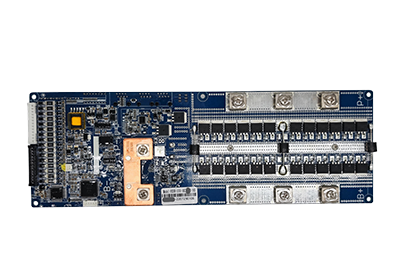
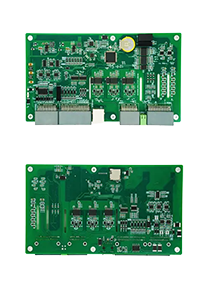


HV BMS EHVS500 is a control and management system specially used for series-connected energy storage batteries. This high voltage battery management system mainly consists of three parts: BCU, BMU and power part. Its main function is to manage and control the battery cluster in the series-connected energy storage battery system. Usually, the BMU module in EHVS500 will be placed in the single battery PACK of the high-voltage system, responsible for monitoring and collecting real-time data such as battery voltage and temperature. The BCU module will be placed in the main control box of the high-voltage system to better monitor and manage the status of the battery cluster. The system mainly consists of three parts: BCU, BMU and power part.

High-voltage BMS plays a key role in energy storage systems, ensuring the efficiency and safety of battery storage and release of energy. Whether it is a home energy storage system or a large-scale energy storage system at the grid level, ENJIE high-voltage BMS can optimize the battery efficiency, extend the battery life, and prevent abnormal conditions such as overcharging, over-discharging, and overheating of the battery by real-time monitoring of battery voltage, current, temperature and other parameters, as well as the remaining capacity (SOC) of the battery.
BCU
1.CAN/RS485/Ethernet communication
2.High-precision current sampling (0.5%), voltage sampling (0.3%), temperature detection
3.Self-developed unique SOC, SOH algorithm
4.BMU automatic encoding address
5.7-way relay acquisition control, support 2-way dry contact output
6.Local large-capacity storage
7.Self-low power mode
8.LCD high-definition display expansion
9.Firmware upgrade: host computer upgrades BCU, BMU firmware upgrades through BCU
10.Local control: dry contact expansion detection
BMU
1.High-speed and stable CAN communication
2. 4-32 battery compatible, real-time voltage sampling
3.2-16 groups of real-time temperature sampling
4.200mA passive balancing function
5.Automatic address allocation in series within the cluster
6.Standby low power design (<1mW)
7.Single-machine dry contact output (maximum current 300mA)
High-voltage battery storage is an energy storage architecture in which multiple battery cells or modules are connected to provide a higher DC operating voltage for an inverter, power conversion system, or industrial energy storage application. Instead of managing the battery only as one complete unit, a high-voltage BMS monitors individual cells, battery modules, and the entire battery cluster. The BMU collects real-time cell voltage and temperature data from each battery PACK, while the BCU evaluates system voltage, current, SOC, temperature, alarms, and charge or discharge status. The high-voltage power section controls relays, pre-charge circuits, and system connection according to the configured protection strategy. This distributed architecture helps identify abnormalities before they affect the complete battery cluster. High-voltage storage is commonly selected when a project requires efficient power conversion, larger system capacity, modular expansion, or compatibility with a high-voltage inverter. The final voltage range must be matched to the battery design and connected equipment.
The main difference in high voltage vs low voltage battery systems is the operating voltage used to deliver the required power. A high-voltage system can transmit the same amount of power with lower current than a lower-voltage system, which may reduce current-related losses and conductor requirements in suitable applications. Low voltage batteries, however, often use simpler system architectures and may be suitable for smaller residential storage, backup power, mobile equipment, or applications with lower power demand. High-voltage systems usually require a distributed BMS architecture consisting of BMUs, a BCU, and a high-voltage control or power unit. They also require coordinated insulation monitoring, relay control, pre-charge management, communication, and system-level protection. The correct choice depends on inverter voltage, required power, battery capacity, installation size, expansion plans, safety requirements, and project cost. Neither voltage platform is universally better; each should be selected according to the complete energy storage system design.
A BMS for high-voltage battery storage uses multiple control levels to monitor and manage the battery cluster. BMU modules are installed in individual battery PACKs or modules to collect cell voltage and temperature data. This information is sent through the communication network to the BCU, which calculates battery status and evaluates system-level conditions such as total voltage, current, SOC, SOH, temperature, alarms, and allowable charge or discharge limits. The BCU can then communicate with the inverter or energy management system and control the high-voltage power components according to the operating state. When overvoltage, undervoltage, overcurrent, excessive temperature, communication failure, or another abnormal condition is detected, the BMS can issue an alarm, restrict operation, or disconnect the battery cluster. A high-voltage BMS may also support cell balancing, data storage, firmware upgrades, relay control, display expansion, and communication through CAN, RS485, or Ethernet, depending on the selected configuration.
Selecting a BMS for high-voltage battery storage starts with confirming the battery chemistry, number of cells in series, PACK configuration, total operating voltage, capacity, continuous current, and peak current. Buyers should also provide the number of battery PACKs, inverter model, communication protocol, relay configuration, pre-charge requirements, temperature-sensor quantity, and required cell-balancing current. The BMS architecture must support the complete battery cluster, including the required number of BMUs and the communication distance between each PACK and the central BCU. Other considerations include SOC and SOH accuracy, data storage, firmware upgrades, dry-contact outputs, LCD expansion, fault logging, and compatibility with CAN, RS485, or Ethernet communication. Installation environment, insulation level, cooling conditions, certification requirements, and future system expansion should also be evaluated. For an accurate BMS configuration, battery manufacturers and ESS integrators should provide a complete system diagram rather than selecting the BMS only according to total voltage or battery capacity.