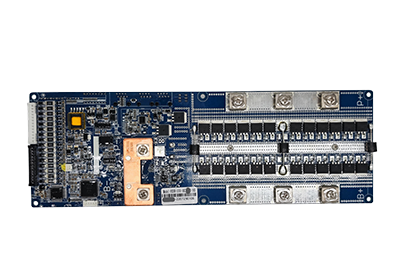
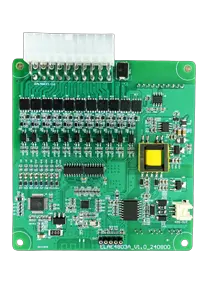


This battery management system board is a fully functional 12~24 series lithium battery equalization management system with active equalization function, which can effectively solve the problem of inconsistent battery cell voltage during standby, charging and discharging. It is 12~24 sections connected in series, with active equalization function.

The active equalizer plays a critical role in mitigating battery risks by collecting essential data to ensure precise monitoring. It gathers information such as balanced circuit current, ambient temperature, bidirectional balanced module temperature, switch array MOS temperature, and DCDC power supply voltage. This comprehensive data collection enables the system to maintain optimal performance and detect potential issues early.
To further enhance safety, the battery management system board incorporates wire break detection to identify and address potential faults within the system. Additionally, the equalizer board performs balanced cell screening, which optimizes battery equalization and improves overall battery performance by ensuring uniform charge distribution across cells.
The equaliser board supports Bluetooth communication, enabling seamless data transfer and remote monitoring for user convenience. To conserve energy, the battery equalisation system features a sleep wake-up function, activating only when needed. For user interaction, the battery management system board offers LED expansion, providing clear visual status indications.
Data storage is another key feature of the active equalizer, allowing the system to log performance metrics and track battery equalization time for detailed analysis. The equalizing charge of battery system is equipped with an alarm protection function, alerting users to potential issues to prevent damage. Finally, the equalizing lithium batteries process monitors balanced cumulative time, ensuring an effective equalizing charge of batteries to maintain long-term battery health and performance.
High energy utilization efficiency:
1. Active balancing: realize energy redistribution with low energy loss.
2. Passive balancing: consume the excess energy of the battery with higher voltage in the form of heat energy through resistance.
Fast balancing speed:
1. Active balancing: the balancing current is 1A-2A, or even up to 10A.
2. Passive balancing: in order to control heat dissipation, the current is about 100mA.
Wide application scenarios:
1. Active balancing: cope with complex scenarios to ensure the performance and safety of the battery pack.
2. Passive balancing: suitable for battery packs with small capacity and low string number.
Balancing in multiple states:
1. Active balancing: regardless of the state of the battery, the state of the battery pack can be monitored and adjusted in real time.
2. Passive balancing: mainly plays a role in the charging process, and has limited ability to solve imbalance problems during discharge and static process.
An active equalizer board works alongside the main battery management system board to improve cell consistency without replacing the BMS protection and monitoring functions. The BMS continues to monitor cell voltage, battery current, temperature, charging status, and fault conditions. When the configured voltage difference or balancing condition is reached, the equaliser board uses its switching and DC-DC circuits to transfer energy from cells with higher charge levels to cells with lower charge levels. This allows the battery to equalize during charging, discharging, or standby, depending on the board configuration. The equalizer may also collect balancing current, board temperature, MOS temperature, power-supply voltage, and wire-connection status for monitoring and fault detection. Communication functions such as Bluetooth or RS485 can allow technicians to review data and configure supported parameters. The BMS and equalizer should therefore be selected as coordinated components based on the battery chemistry, series count, voltage range, and required balancing current.
Selecting an equalizer board starts with matching the board to the battery pack’s series count, chemistry, cell voltage range, and required balancing current. When equalizing batteries in series, every cell-monitoring connection must correspond to the correct cell position, and the board must support the complete string configuration. Buyers should also evaluate battery capacity, expected cell-voltage difference, charging and discharging current, temperature range, installation space, and whether balancing is required during charging, discharging, standby, or all three states. Communication and maintenance requirements may include Bluetooth monitoring, RS485 integration, data storage, alarm reporting, firmware configuration, or external installation for easier replacement. ENJIE’s listed ELAE4803A, for example, is designed for 16S LFP or NCM packs, provides 3A active balancing, and supports Bluetooth with an RS485 interface reserved. Final selection should be based on the actual battery design rather than using balancing current or cell count as the only criteria.
An equalizing charge of batteries traditionally refers to a controlled charging procedure commonly associated with certain lead-acid batteries. It may intentionally raise the charging voltage to address electrolyte stratification or differences between cells. This approach should not be confused with active battery equalisation in a lithium battery pack. When equalizing lithium batteries, an active balancer transfers energy between cells according to monitored voltage and configured control conditions. Applying a generic lead-acid equalizing-charge procedure to lithium cells may exceed permitted cell-voltage limits and should not be performed unless it is explicitly supported by the battery manufacturer and charging system. For lithium applications, the correct approach is to use a compatible BMS and balancing solution that matches the chemistry, series count, voltage thresholds, temperature limits, and protection strategy. Therefore, buyers searching for an equalizing charge of battery should first identify the battery chemistry and determine whether they need a charging procedure or an electronic active equalization board.

