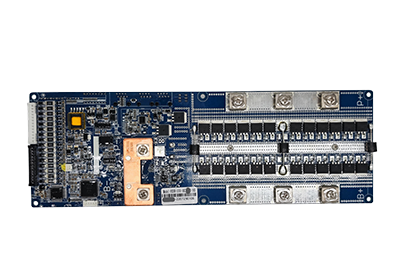

A parallel BMS is designed to coordinate multiple battery PACKs connected to a common high-voltage system. In this architecture, adding PACKs in parallel increases the available energy capacity while the system voltage remains within the designed operating range. Each PACK requires independent data acquisition so that cell voltage, temperature, operating status, and fault information can be monitored rather than relying only on total system values. When the BMS in parallel receives this information, the central control unit can evaluate the condition of each PACK and coordinate charging, discharging, protection, and communication with the inverter or energy management system. This structure is particularly useful when an energy storage project needs modular capacity expansion without redesigning the entire voltage platform. A properly engineered parallel system must also consider PACK consistency, current sharing, SOC differences, communication logic, and fault isolation before multiple battery units are connected.
A BMS parallel connection begins with each battery PACK collecting real-time cell voltage and temperature data and reporting it to the battery control unit. The BCU combines these measurements with system current, charging and discharging status, SOC, and alarm information to determine whether every PACK can operate safely on the shared DC bus. In a DC-DC-based architecture, the control system can coordinate the voltage and current contribution of individual PACKs instead of allowing uncontrolled current flow between batteries. The BMS parallel system also exchanges operating commands and status data with the inverter or energy management system through the required communication protocol. When a PACK shows abnormal voltage, temperature, SOC, or communication status, the system can limit its output, trigger an alarm, or isolate it according to the configured protection strategy. The final control logic should always be matched to the battery chemistry, PACK configuration, inverter, and project requirements.
A parallel BMS gives battery manufacturers and energy storage integrators a practical way to expand system capacity through a modular PACK architecture. Additional battery PACKs can be incorporated without changing the basic system voltage, making phased capacity expansion easier for projects whose energy demand may grow over time. With the BMS in parallel, each PACK can be monitored independently, helping technicians identify voltage, temperature, SOC, communication, or fault differences at the PACK level. This modular structure can also simplify maintenance because an abnormal unit can be inspected or serviced without treating the entire battery bank as a single undifferentiated system. Centralized battery-cluster management supports coordinated protection and communication with the inverter, while a suitable DC-DC control strategy can improve current coordination among parallel PACKs. For B2B buyers, the main value lies in scalability, maintainability, clearer fault diagnosis, and the ability to configure a high-voltage ESS around project-specific capacity and expansion requirements.
A parallel BMS and a series high-voltage BMS serve different system expansion goals. In a parallel architecture, multiple battery PACKs are connected so the total available capacity increases while the operating voltage remains within the selected system range. This makes BMS parallel solutions suitable for modular projects that need additional runtime or energy capacity without raising the DC bus voltage. A series high-voltage system, by contrast, connects battery modules in series to increase the total voltage while maintaining the capacity of the series string. Its control architecture focuses on monitoring modules across a high-voltage battery cluster and coordinating the BCU, BMU, and high-voltage power unit. Selection should therefore be based on the inverter voltage window, required energy capacity, charge and discharge current, future expansion method, and battery PACK design. Neither architecture is universally better; the correct choice depends on whether the project primarily needs higher voltage, greater capacity, or a combination of both.
Selecting a BMS parallel box starts with confirming the rated and operating voltage of each battery PACK, the required continuous and peak system current, and the number of PACKs that will operate in parallel. The battery chemistry, cell configuration, capacity, SOC range, and internal resistance should also be evaluated because inconsistent PACK characteristics can affect current sharing and system stability. A suitable BMS parallel connection must support the inverter or EMS communication protocol required by the project, such as the applicable CAN or RS485 interface, and provide the necessary data acquisition, protection, alarm, and fault-isolation logic. Buyers should also confirm whether future capacity expansion, display functions, firmware upgrades, remote monitoring, or customized communication mapping will be required. Before quotation, provide the supplier with the battery voltage, current, chemistry, PACK quantity, inverter model, communication protocol, application environment, certification requirements, and expected expansion plan so the hardware and control strategy can be evaluated together.
A parallel BMS is suitable for high-voltage energy storage projects that require scalable capacity, modular battery PACK management, and coordinated communication with an inverter or energy management system. Typical applications include commercial and industrial energy storage, solar-plus-storage installations, modular ESS cabinets, microgrid support, high-capacity backup power, and projects planned for phased expansion. Using the BMS in parallel allows system designers to increase available energy by adding compatible PACKs while maintaining the required high-voltage platform. This is useful when a project must adapt to changing load demand, longer backup duration, or future capacity upgrades. The final application range depends on the PACK voltage, system current, battery chemistry, inverter compatibility, environmental conditions, and protection requirements. For each project, the parallel architecture should be engineered around consistent PACK characteristics, reliable communication, current coordination, thermal management, and fault isolation rather than treating parallel connection as a simple electrical wiring change.