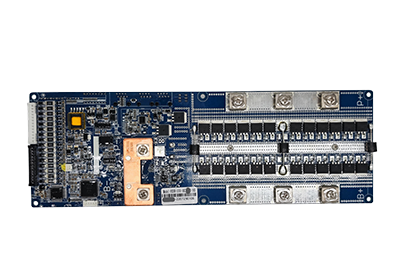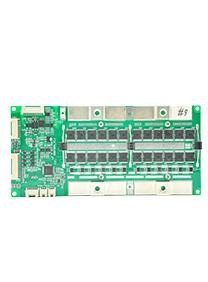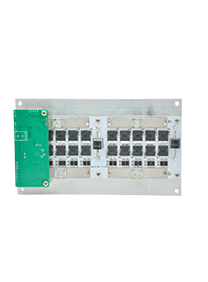

This product is a comprehensive 4-cell lithium-ion battery management system with protection and recovery functions such as single cell overvoltage/undervoltage, total voltage undervoltage/overvoltage, charge/discharge overcurrent, high temperature, low temperature and short circuit. It can achieve accurate SOC measurement and SOH health status statistics during the charging and discharging process. It can also achieve voltage balance during the charging process.
Real-time acquisition and monitoring of 4-cell voltages for cell overvoltage and undervoltage alarms and protection. The cell voltage detection accuracy is ≤±20mV at -20~70℃, and the PACK voltage detection accuracy is ≤±0.5% at -20~55℃.
Real-time acquisition and monitoring of 2 cell temperatures, 1 environment temperature and 1 power temperature by NTC for high and low temperature alarms and protection. The temperature detection accuracy is ±2℃.
Real-time acquisition and monitoring of battery pack charge and discharge current by current detection resistor connected to the main charge and discharge circuit for charge and discharge current alarms and protection. The current accuracy is ≤±2% below 10A and ≤±1% above 10A at -20~70℃.
The 12v lithium BMS has the function of output short circuit detection and protection.
A BMS 12V LiFePO4 system protects the battery by continuously comparing cell and PACK data with configured safety thresholds. The BMS measures the voltage of each of the four series-connected cells so that one cell cannot become excessively charged or discharged while the total PACK voltage still appears normal. It also measures charge and discharge current through the main circuit and can disconnect or limit the battery output when an overcurrent or short circuit condition is detected. Temperature sensors monitor the cells, surrounding environment, and power components to help prevent charging or discharging outside the permitted temperature range. During charging, the 12V BMS LiFePO4 solution can balance cells with higher voltage to improve consistency across the battery pack. More advanced models can calculate SOC and SOH, record operating information, and communicate battery status to an external controller. Protection parameters should be configured according to the cell manufacturer’s specifications and the actual battery application.
A LiFePO4 BMS 12V solution supports battery manufacturers developing lithium battery packs intended to replace conventional 12V lead-acid batteries. Although both battery types are commonly described as 12V systems, their cell chemistry, charging characteristics, voltage curves, protection needs, and state-of-charge behavior are different. A LiFePO4 replacement pack therefore requires a dedicated BMS rather than relying on the protection or charging assumptions used for a lead-acid battery. The BMS monitors the four-cell lithium pack, controls charging and discharging protection, balances cell voltage, and provides battery status information where supported. Buyers must also confirm that the existing charger, load, inverter, or vehicle electrical system is compatible with the lithium battery’s operating voltage and charging requirements. ENJIE positions its 12V BMS range for lead-acid-to-lithium conversion and small energy storage applications, with available smart and standard configurations for different communication and cost requirements.
ENJIE provides smart and standard options for customers selecting a 12V BMS LiFePO4 solution. The EMU1204 smart BMS is intended for projects that require external communication, software-based monitoring, or more advanced battery data functions. It supports 4S LFP or NCM battery configurations and is available with current options including 100A, 150A, and 200A. A smart BMS 12V LiFePO4 system may support SOC and SOH information, communication with external equipment, parameter configuration, and automatic addressing for supported parallel applications. The EMU1202 standard BMS is positioned for lower-cost projects that do not require external communication but still need essential monitoring and protection functions. Both options should be selected according to battery chemistry, continuous current, peak load, communication requirements, PACK design, and operating environment. Buyers should not select solely by current rating because thermal design, cable size, connector configuration, enclosure conditions, and application duty cycle also affect system suitability.
Selecting a LiFePO4 BMS 12V begins with confirming that the battery pack uses a 4S LiFePO4 configuration and identifying its nominal capacity, operating voltage range, continuous current, peak current, and expected load profile. The selected BMS must support the required charge and discharge current without exceeding the thermal and electrical limits of the MOSFETs, cables, connectors, and battery cells. Buyers should also determine whether the application requires only hardware protection or a smart 12V BMS LiFePO4 with SOC, SOH, communication, parameter configuration, or external equipment integration. Additional selection factors include charging temperature, discharge temperature, balancing requirements, enclosure space, cooling conditions, charger compatibility, inverter communication, and whether multiple battery packs will be connected in parallel. For an accurate recommendation, provide the cell chemistry, cell model, PACK capacity, maximum current, charger specification, load type, communication protocol, installation environment, and required certification or customization information before the final BMS configuration is confirmed.